


Pottery and ceramic craftsmanship in Senegal represent an essential part of the country’s cultural heritage. This activity, which dates back several millennia, is far more than a simple trade: it embodies an ancestral know-how, passed down from generation to generation, and a deep connection to the daily life, beliefs, and traditions of the country’s various communities. Today, Senegalese pottery skillfully blends tradition and innovation, while playing an important role in local economic development and cultural promotion. This article takes you on a journey through the history, techniques, uses, key regions, challenges, and future prospects of this unique craft.
1. The Origins and History of Senegalese Pottery
Pottery in Senegal has its roots thousands of years in the past, at a time when the first settled populations were already using clay to make utilitarian objects essential to their survival. Archaeological excavations carried out in various regions of the country, particularly near the Senegal River, have revealed remains of very ancient pottery. These early creations mainly had a practical function, used for storing water and food, as well as for cooking. This craft activity was closely tied to the natural environment and local resources, with clay being gathered directly from riverbeds or clay-rich soils nearby. From the outset, pottery carried significant social importance, notably because it allowed the community to store and preserve its resources.
Over the centuries, Senegalese pottery grew richer in shapes, decoration, and function. Each ethnic group developed a distinctive style reflecting its culture, beliefs, and way of life. The Diola, for example, known for their strong connection to nature and tradition, produce specific pottery used in religious rites and ceremonies. The Wolof, on the other hand, favor utilitarian forms intended for everyday urban or rural life. Techniques were passed down mainly through oral instruction and hands-on practice, often within families, which ensured strong cultural continuity. This long and diverse history gives Senegalese pottery a symbolic and aesthetic richness that goes well beyond its original purpose.
Finally, pottery has long been a predominantly female domain, with women serving as the main keepers of this craft knowledge. They taught their daughters the precise gestures needed to shape and decorate pieces, along with the cultural meanings behind the motifs. This intergenerational transmission is key to the survival of this art form. However, some men also took part in certain stages of the process, particularly the firing of pottery, a delicate operation requiring strength and skill. This division of labor, though traditional, illustrates the complexity and depth of a craft that remains today a powerful symbol of Senegalese cultural identity.
2. Traditional Manufacturing Techniques
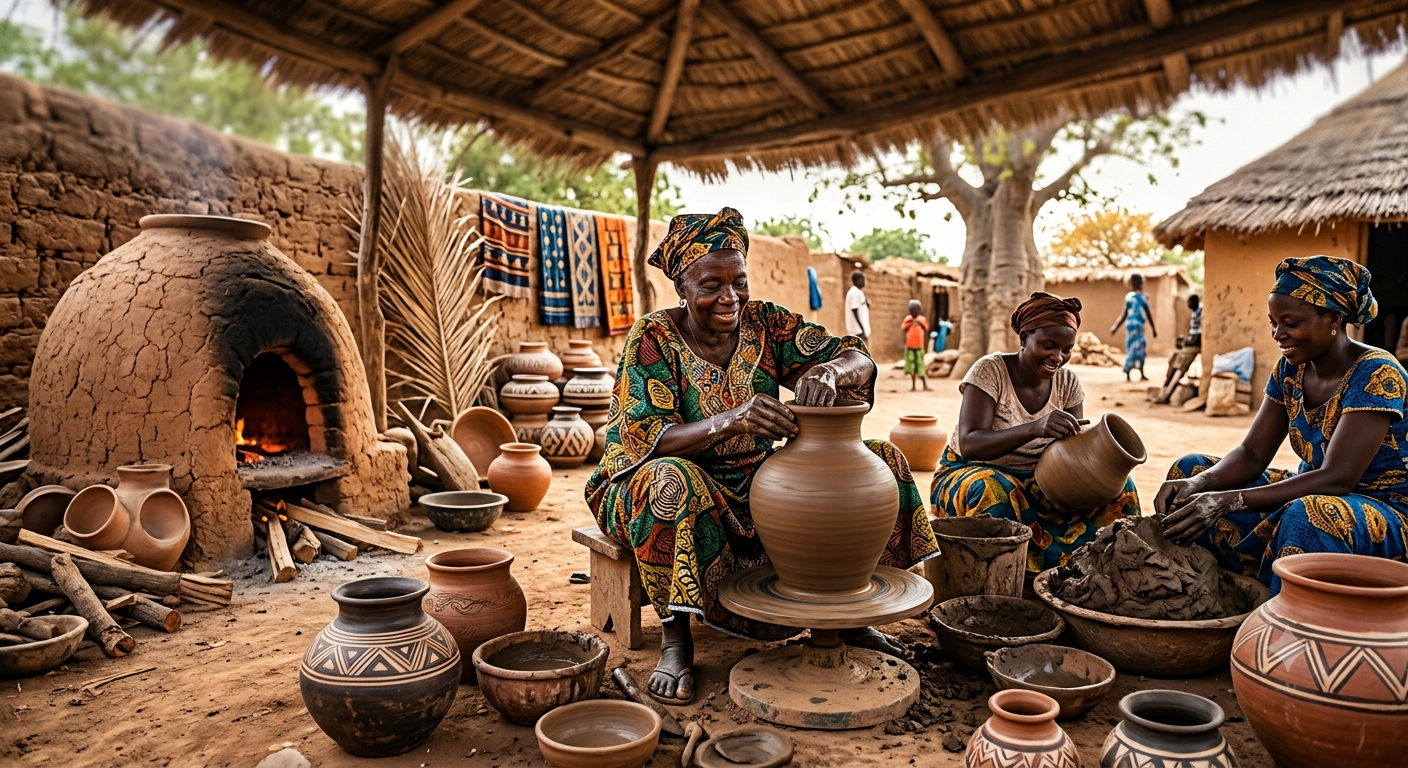
The making of pottery in Senegal relies on ancestral methods that require patience, mastery, and attention to detail. The first crucial step is gathering and preparing the clay, a raw material readily found in several regions of the country. The clay is carefully extracted, then sifted and kneaded to remove impurities and achieve a smooth, malleable paste. This preparation is essential to the quality of the final product, since poorly worked clay risks cracking during firing or developing flaws. The artisan must therefore be able to judge the ideal consistency and texture, a skill acquired only through experience.
Shaping the pottery is essentially done by hand, which gives each piece great authenticity. The coiling technique is particularly widespread: long rolls of clay are rolled out and stacked in a spiral to build up the desired shape. This method allows for a wide variety of objects, from large storage pots to elegant vases. Unlike other cultures where the potter’s wheel is commonplace, here hand-molding takes precedence, making each creation unique and slightly different from the next. For decoration, artisans use simple tools, often made by themselves, to incise or stamp traditional patterns that tell a story or symbolize elements of nature or spirituality.
Firing the pottery is the final and arguably the most delicate step. Pieces are first slowly air-dried to prevent cracking, then fired in traditional kilns or open-air hearths. Controlling the temperature is an art in itself, since firing that is too fast or too intense can irreparably damage the pieces. This stage demands a great deal of experience and skill, and in some regions is reserved for men. The final result is sturdy ceramic ware in natural tones, suitable for both everyday household use and decoration.
3. Traditional and Contemporary Uses of Senegalese Pottery
Traditionally, Senegalese pottery served mainly domestic and practical needs. The objects produced were used to store water, grain, and dry food, as well as to cook certain dishes. Pottery therefore played a central role in the daily organization of households, helping to preserve resources and prepare meals. Pieces were designed to withstand heavy use and heat, with shapes suited to each specific function. For example, some pots were narrow to limit water evaporation, while others were wider to make cooking over a wood fire easier.
Beyond this utilitarian aspect, pottery also carried significant social and spiritual meaning. Among several ethnic groups, decorated pottery was used in traditional rites, initiation ceremonies, and festive events. Specific patterns and shapes could symbolize spiritual concepts or recount ancestral legends, reinforcing the cultural role of these objects. Some pottery pieces were even intended for ritual uses, such as offerings or fertility ceremonies, highlighting the symbolic richness of this craft.
Today, Senegalese pottery is experiencing a revival thanks to the growing appreciation of local craftsmanship and rising tourist interest. Pottery is now also valued for its aesthetic and artistic dimension. Many contemporary artisans blend traditional techniques with creative innovation to offer unique pieces that appeal to both local and international clients. This evolution is diversifying the uses of pottery, which is now also finding a place in interior decoration and craft design. This dual function, both utilitarian and artistic, reflects the vitality and adaptability of this craft.
4. Emblematic Regions and Renowned Artisans
Certain regions of Senegal have distinguished themselves for the quality and diversity of their ceramic production. The Thiès region, close to Dakar, is undoubtedly one of the most dynamic centers for traditional pottery. It is home to numerous workshops where artisans keep ancient know-how alive while welcoming visitors eager to discover the craft. Thiès’s craft markets also serve as meeting points between artisans and buyers, offering an important showcase for these creations. Proximity to the capital makes it easier to distribute pottery through tourist and commercial channels.
The Fatick region, particularly around Joal-Fadiouth, is another area well known for its pottery. Here, the Serer tradition remains very much alive, and pottery plays a central role in cultural practices. Pieces are made using precise techniques and decorated with distinctive patterns, giving them a strong identity. These objects, often made within family settings, are highly valued by both local communities and foreign visitors, contributing to the region’s tourist appeal through craft markets and exhibitions.
Finally, Dakar, as the capital, is home to many ceramic artisans who play a key role in modernizing and promoting Senegalese pottery. These creators innovate by combining traditional techniques with contemporary forms, taking part in national and international exhibitions. Their work helps broaden the visibility of Senegalese pottery and open new markets, particularly in interior decoration and contemporary art. This dynamism helps renew the image of the craft and secure it an important place in the country’s cultural economy.
5. Challenges Facing Ceramic Craftsmanship in Senegal
Despite its cultural importance and economic potential, Senegalese pottery faces several major challenges that hold back its development. One of the most significant is growing competition from modern industrial materials such as plastic, metal, and factory-made ceramics. These alternatives, often cheaper and more durable, tend to reduce demand for handmade pottery, putting traditional artisans at a disadvantage. This economic competition is compounded by waning interest among younger generations, who tend to favor more lucrative or less demanding trades.
In addition, weak commercial and logistical infrastructure poses a major obstacle. Many artisans lack easy access to national and international markets and have limited means to effectively promote their products. A lack of training in marketing, management, or innovation also limits their ability to adapt to the demands of a globalized market. This situation often leads to economic precarity, which threatens the transmission of traditional skills that remain essential to the craft’s survival.
Finally, the question of promoting and recognizing Senegalese pottery remains crucial. While some local and international initiatives are working to promote this heritage, greater efforts are needed to fully integrate pottery into the country’s cultural and economic policies. Institutional support, training, workshop modernization, and the creation of artisan networks are all essential levers for preserving this heritage while ensuring its sustainable development.
6. Future Outlook and Potential of Senegalese Pottery
Despite these challenges, numerous opportunities are opening up for pottery and ceramic craftsmanship in Senegal, particularly thanks to the rise of cultural tourism and the creative economy. Growing interest in authentic, handmade products represents a real opportunity for artisans, who can reach local and international customers eager to own objects rich in history and soul. The development of tourist circuits that include visits to workshops and craft markets also helps showcase local know-how while generating additional income.
Artistic innovation also plays a key role in sustaining Senegalese pottery. Many young artisans are incorporating modern techniques, new forms, and contemporary designs, allowing them to diversify their offerings and access new markets, particularly in interior decoration and contemporary art. This blend of tradition and modernity fosters a dynamic renewal of the craft and contributes to the international recognition of Senegalese ceramics. It also helps attract new talent and encourages professional training in the field.
Finally, increased support from public authorities, non-governmental organizations, and private stakeholders is essential to structuring this sector. Establishing cooperatives, facilitating access to financing, providing technical and business training, and promoting the craft nationally and internationally could all serve as strong avenues for development. Senegalese pottery has real potential to become a driver of local economic and cultural development, provided it receives appropriate and sustained support.
Conclusion
Would you like to discover the authenticity and richness of Senegalese craftsmanship, including traditional pottery and ceramics? Turn to SENEGAL SHUTTLE, your trusted partner for a unique cultural journey through Senegal’s regions and their ancestral know-how. With Senegal Shuttle, explore the workshops of passionate artisans, support the local economy, and enjoy an authentic experience at the heart of Senegal. Don’t wait to book your custom cultural tour and immerse yourself in the fascinating world of Senegalese pottery!


Leave a Comment